

Advice
most suitable design and the conditions on the project location.
For the design of the breakwater, there has been executed a literature study on four different variants of a breakwater. The literature study can be found in the investigation report ‘Onderzoek naar de meest geschikte golfbreker voor de North Sea Wind Power Hub’, which is added to the projectmap.
The outcome of the literature study is, that for de conditions on the project location, the conventional breakwater with Xbloc elements in the armour layer, is the most suitable design.
the conditions on the project location are:
| Water depth: | 17 meters |
|---|---|
| Hs: 4.2 meters | 4.2 meters |
| Material on the seafloor: sand | sand |
| Direction of the sea current: Northwest | Northwest |
| Normative wind direction: West and Northwest | West and Northwest |
design process of the breakwater
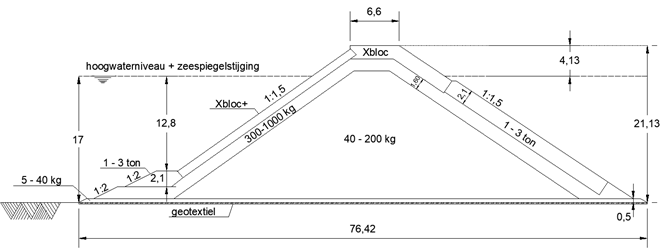
The conditions on the project location forms the basis for the design of the breakwater. First of all the height of the breakwater is calculated. With the requirement of a maximal wave height of 1 meter in the harbour, the transmissions coefficient could be determined. With the transmission coefficient the breakwater height is calculated on 20.5 meters. The extensive calculation can be found in the investigation report ‘Onderzoek naar de meest geschikte golfbreker voor de North Sea Wind Power Hub’.
After the calculation of the height of the breakwater, the size of the Xbloc elements is calculated. The front armour of the breakwater consist of Xbloc+ elements with a unit volume of 2.5 m³. the crest – and rear armour consist out of Xbloc element with a unit volume of 2.0 m³.
The filter layers of the breakwater are designed on the basis of two requirements:
Df15/Db85 < 4 à 5 geometric close filter for current
Mf50/Mb50 < 10 à 15 filter rule during wave attack.
The first filter layer is handed by the report ‘Guidelines for Xbloc concept design’. In this report the advised rubble stone grading is 300 – 1000 kg. The next layers are designed with the two requirements. The toe and the rubble stone in the rear armour are also designed with the ‘Guidelines for Xbloc concept design. In table 4.1 the structures of the different breakwater sections are presented.
| Breakwater section | Section material | Layer Thickness (m) |
|---|---|---|
| Soil protection | geotextile | - |
| Soil protection | rubble stone grading 5-40 kg | 0.50 |
| Core | rubble stone grading 40-200 kg | - |
| Filter layer | rubble stone grading 300-100 kg | 1.60 |
| Front armour | Xbloc+ elements, unit volume 2.5 m³ | - |
| Rear armour | Xbloc elements, unit volume 2.0 m³ | - |
| Rear armour | rubble stone grading 1-3 ton | 2.10 |
| Toe | rubble stone grading 1-3 ton | 2.10 |
| Crest | Xbloc elements, unit volume 2.0 m³ | - |
After designing the different sections of the breakwater a final design is drawn in autocad. The final design is shown in figure 4. 2.
calculation of the quantities and the total costs
The quantities of the breakwater are calculated, using the autocad drawing.
The total amount of construction materials are calculated in het investigation report ‘Onderzoek naar de meest geschikte golfbreker voor de North Sea Wind Power Hub’. In this advice report, only the outcome of the calculations are given.
The total length of the breakwater construction is 734 meter. The surface of the breakwater is equal to 56092,28 m². the total amount of construction materials are given in table 4.3.
| Material | Amount |
|---|---|
| Geotextile | 56093 m² |
| Rubble stone grading 5-40 kg | 27,745.2 ton |
| Rubble stone grading 40-200 kg | 1,010,321 ton |
| Rubble stone grading 300-1000 kg | 261,201 ton |
| Rubble stone grading 1 – 3 ton | 53,620 ton |
| Xbloc elements | 3326 units |
| Xbloc+ elements | 7181 units |
The total costs of the breakwater are calculated, using a graduation research from 1998, on the TU-Delft. In this graduation research the costs, for constructing a breakwater are given in Dutch guilders. To calculated the contemporary total costs of the breakwater, the total costs in Dutch guilders are converted to the total costs in euros. After that, the costs are multiplied with the ratio between the consumers price index of 1998 and 2018. The total costs of the breakwater construction are given in table 4.4 .
| Costs in Dutch guilder 1998 | Costs in euros 1998 | Costs in euros 2018 |
|---|---|---|
| 46.418.134 | 20.888.160 | 30.287.832 |
Create Your Own Website With JouwWeb