

Advice
The paving construction of the runway must be designed for the airport. in order to be able to design the pavement construction, considerations and calculations will have to be made. These are made through research on the internet. We look at the loads that occur on the paving, what material must be used and how the pavement can be realized.
The following question will therefore be answered in this document:
How is the paving and foundation construction of the airport on the island structured?
With this as the main question, the next 4 side questions are asked to aid with the research:
- What are the loads that occur on the paving?
- What material is the top layer made of?
- What different layers does the foundation construction consist of?
- How can the pavement construction be realized?
Forces
In the first sub-question, we investigate which loads occur on the paving. Because it is not known how many people should go to and from the island, an assumption is made that 2 times a month about 80 people can come to the island. Hereby an aircraft was found with the following dimensions:

| Embraer 170 | |
|---|---|
| PASSENGERS | 78 |
| MTOW | MTOW |
| (KG) | 36.000 |
| MLW | MLW |
| (KG) | 32.800 |
| TOR | TOR |
| (M) | 1644 |
| LR | LR |
| (M) | 1274 |
| WINGSPAN | 26.00 |
The weight of the aircraft is 36,000 kg. Of this, 95% is transferred to the wheels. The chassis consists of 2 wheels.
| MTOW | 95% | Wheels | MWL |
|---|---|---|---|
| 36.000 Kg | 34.200 | 2 | 17.100 |
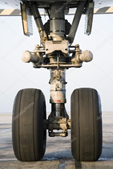
The landing gear is divided into 2 wheels and 47.5% of the weight is Transferred per wheel. A weight of 17,100 Kg per tire is therefore carried to the ground.
The tire pressure is 869 kPa.
The diameter of the wheel contact surface on the subgrade is:
17.100 / 0,869 MPa (0,869 N/mm2) = 19.677
19.677 / π = 6.263
= 79,14
79,14 * 2 = 158,28 mm
Material
Different materials can be used for the top layer of the paving. Because the calculations are made with FAARFIELD, Hot mix asphalt (HMA) & Portland cement concrete (PCC) is used.
The start and end of the runway are made from PCC. These are the places where the aircraft is stationary to take off and concrete can handle stationary loads better. Asphalt would deform on a hot day.
Asphalt is a flexible material and is cheaper to install than concrete, but requires more maintenance over its useful life. Asphalt cannot support large loads and slowly deforms under load. The asphalt is never completely stiff and can therefore be used on an unstable basis. Because asphalt can deform, bumps can arise, which shortens the total lifespan of a runway. Asphalt is porous and can therefore drain water. As there is a high level of humidity in the North Sea all year round, including in the summer, so there is a lot of rain, it may be good to use asphalt.
Concrete is a rigid material and requires little maintenance but is more expensive to install. It can support a high load and lasts a long time. Concrete requires a stable base because it is rigid. The concrete is built in slabs with gaps. They are needed because of thermal expansions that can occur. When concrete starts to crack or is damaged in any other way, it must be re-laid in large slabs.
Asphalt and concrete could also be combined. Concrete with a layer of asphalt over it can ensure the strength of concrete and the flexibility of asphalt. The asphalt also protects the concrete against the weather. A combined runway would therefore be best in this situation.
Foundation calculation
The foundation construction will be calculated with FAARFIELD
To be able to calculate a combined concrete construction with an asphalt cover, an HMA overlay will be applied to a rigid PCC pavement in FAARFIELD. In the design of this paving, the deterioration of the SCI (Structural Condition Index) of the existing PCC is being considered.
The island is made of sand. So an MPa of 120 is entered for the subgrade.
In FAARFIELD there is a minimum to use 4 layers when making a calculation. So an indefinite layer
with a minimal E-modulus and a minimum layer thickness was used to solve the problem of 4 layers.
By calculating different thicknesses of the concrete with the minimum indefinite layer, the following results for the thickness of the asphalt and the service life came from the calculation, shown in the table below.
| Thickness concrete (MM) | Thickness asphalt (MM) | Lifespan (Years) |
|---|---|---|
| 200,5 | 51,0 | 20,0 |
The indefinite layer could also get the MPa of sand. By calculating different thicknesses of the concrete with the indefinite layer with an MPa of sand, the following result for the thickness of the asphalt and the lifespan came from the calculation, shown in the table below.
| Thickness concrete (MM) | Thickness asphalt (MM) | Lifespan (Years) |
|---|---|---|
| 187,8 | 51,1 | 20,0 |
In the calculation with the indefinite layer of MPa 120, so that the layer functions as sand, less concrete is required than in the case of the indefinite layer with a minimum MPa. This is because the minimum layer has less bearing capacity.
A structure with a concrete thickness of 200.5 mm would therefore last exactly 20 years when using a minimum indefinite layer. A construction with a concrete thickness of 187.8 would also last 20 years for the 120 MPa indefinite layer.
The runway is therefore built on a sand base and consists of a concrete layer of 190 mm and an asphalt cover 50 mm. The total construction that must be placed is 240 mm = 24.0 cm.
Because during the laying of the concrete road and the asphalt layer, the figures behind the comma are probably not taken into account, the concrete layer has been rounded up to 190 mm, so that the asphalt cover can be rounded down to 50 mm.
Realisation
The pavement of the airport will only be realized in one of the final phases. At that time the harbor is already present and all materials needed to realize the paving construction can be imported via the harbor. the concrete and asphalt are produced on the island by power stations. these power stations are already present in earlier phases or required in subsequent phases of realization.
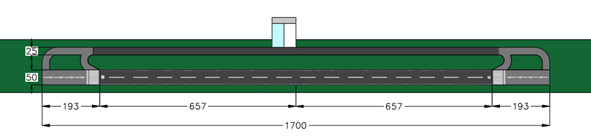
The runway is 50 meters wide and 1700 meters long. The first 190 meters at the start and end of the runway has no asphalt cover and only consists of concrete. Parts of the taxiway also consists of concrete. This is because those are places where the aircraft can stand still. The rest of the runway and taxiway will be realized as described in sub-question 3.
To be sure of a stable surface, the sand is first compacted. this will be done by driving over the sand with a vibrating roller. This reduces the volume of the sand and increases the carrying capacity.
The concrete cannot be poured directly onto the sand. So a layer of geotextile is used to separate the sand and the concrete. The concrete is not poured in its entirety but in slabs. This is so that when the concrete is cracked, a plate can be replaced instead of the entire surface. A dilation joint can also be used to account for the expansion and contraction of the concrete. After the concrete has hardened long enough, asphalting can take place. this is done with an asphalting machine.
Create Your Own Website With JouwWeb